
Anatomy of a Fence

What do you call the collective parts and pieces of a fence? Fence anatomy?
People have been constructing fences of all kinds since civilization began. In fact, It’s surprising that there has never been a standard specification from a formal fence trade association that we can follow for a uniform fence terminology. Therefore, we at Rain City Fence decided to define the various parts and pieces ourselves.
Our own DIY, if you will.
This effort is helpful for a fence building company to communicate with our neighbors what parts and pieces we’re talking about when discussing a fence installation for their home. It’s also helpful to reference when writing up a scope of work in a construction contract so the neighbor and the contractor are on the same page.
In addition, it’s helpful, if not critical, for estimators to talk to fence installers and, in turn, fence install leads or foremen to speak with their team members, to create a uniform terminology for each piece of a fence, be it traditional- or modern-style structure. With that, Rain City Fence offers our own terms for fence anatomy for each part of a given fence.
Defining Our Fence Anatomy
- Posts
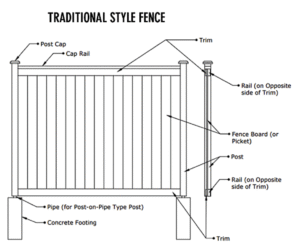
These are vertical poles or supports anchored in the ground and stabilized by concrete roughly a foot-and-a-half to two feet in the soil. Between the cedar and the cement, Rain City Fence employs a “post-on-pipe” method to secure the cedar wood posts from the soil and concrete, which causes faster decay in the wood over the years.
- Rails
Rails on a fence are the boards placed horizontally that connect each post to the next. Rails play a central role in maintaining the structural integrity and stability of the whole by distributing even weight to each post. The number of rails depends on the type of fence being built; some simpler fences are single rail while others feature multiple elaborate tiers for additional strength and aesthetic grandeur.
- Concrete Footing
A concrete footing is a base of concrete characteristically poured into a hole in the soil a foot to a foot-and-a-half deep below the frost line. This step helps to prevent posts from moving, shifting, or heaving due to the elements, general soil moisture, and particularly during freeze-and-thaw cycles.
- Pipe
The pipe involved in the “post-on-pipe” method used by Rain City Fence refers to the metal pipe, customarily galvanized steel, that extends out the bottom of the cedar fence post and embeds in the concrete footing. Used as a support for the cedar post, the pipe functions to lift the cedar wood post off the ground in order to protect the wood from exposure to the soil and moisture, preventing any rotting from taking place.
- Pickets
The vertical or horizontal boards attached to the rails in a vertical design or posts in a horizontal design, pickets are the attention-getters, the eye-catchers, in the fence anatomy. Pickets add security to a fence and the signature elegance many homeowners admire and adore. Homeowners can decide upon a number of picket styles including flat, rounded, or pointed, formatting the fence design to their personal specifications and the preferred aesthetic that fits their property best.
- Fill-in Boards
Sometimes the pickets just don’t fill in evenly, and you need a “fill-in board” to shore up the extra gap in the fence panel. Fill-in boards are measured and custom-cut on-site to ensure a uniform and continuous appearance for the panel.
- Gates
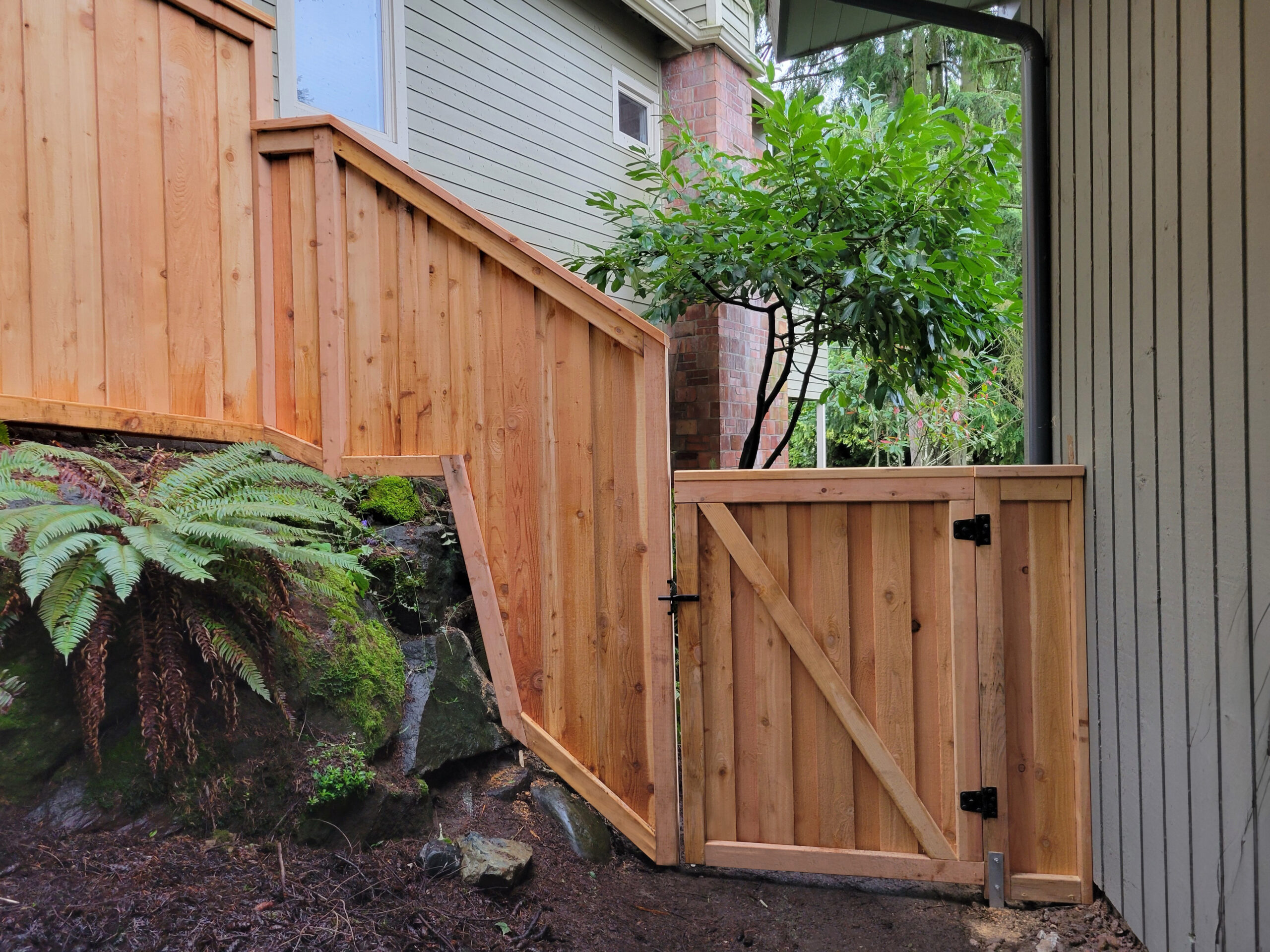
While a fence doesn’t necessarily need a gate, depending on the utility, many homeowners find it necessary for practical access around the home or functionality by way of security, property value, and general privacy. There are a lot of choices to make in choosing the style of gate. Does it fit the rest of the fence design? Is it a pedestrian gate or a gate for your car? Select a gate that works practically, functionally, and aesthetically for what your house requires. 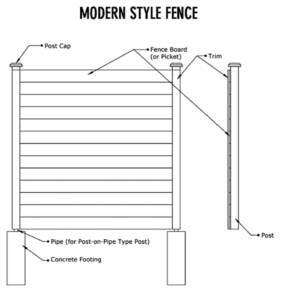
- Panels
Sometimes a short-cut is a good thing! Pre-fabricated, pre-assembled panels consist of rails and pickets that make the fence installation process faster, more simple, and ensures a uniform look and appearance. Regardless of functionality or aesthetic, panels offer homeowners a flexibility and speed of installation.
- Kickboards
You can probably imagine where a “kickboard” belongs in the overall function of a given fence. A kickboard is placed at the bottom of the fence in order to lend a protective function and a completed look to the design of the fence. This horizontal board serves as a barrier between the moisture of the soil and the valuable cedar wood, not unlike the post-on-pipe method employed by Rain City Fence for each post.
- Caps, or Top Caps
Caps are those ornamental pieces that are added to the top of fence posts to both protect the end grain of the cedar post from the weather while offering a little design flare to the overall structure. A top cap, however, is a horizontal board that is placed on top of the pickets and supporting rail in a vertical, traditional fence design. While offering a finished, completed look for the fence, top caps protect the end grain of the pickets from harmful moisture.
- Trim
Like caps, trim acts as a cosmetic aesthete to a fence build. Horizontal boards are added to the tops and bottoms of a given fence, often titled a “cap and trim” style to offer a finished, complete appearance while providing added structural support and protecting the interior from moisture.
With these given terms your company, and the neighbors you’re building for, will be able to communicate and understand the details, tasks, and work required to get the job done as quickly and efficiently (and joyfully!) as possible.
Go ahead and click for a free estimate from Rain City Fence or check out our work. We hope to speak with you!
continue reading
Related Posts
If you’re researching cedar fence cost Bellevue homeowners typically pay, […]

If you’re planning cedar fences Bellevue homeowners rely on for […]