
How To Prepare For Your Home’s Fence Building Project

There comes a time for many homeowners when the need for a new fence building project or replacement for an existing fence becomes unavoidable. First of all, congratulations! That’s quite a big step for you, your family, and even your next-door neighbors. It’s a positive step for achieving whatever solution helps your family’s quality of life at home.
Okay, we readily admit the process can be a tad overwhelming at first, depending on the number of preliminary steps you decide to start from; adhering to HOA guidelines, coordinating or negotiating with neighbors, or just getting the best estimate or quote from local fence building companies.
The reality is your upcoming fence installation can actually be pretty simple and straightforward if you break them into specific steps, as we have done for you below:
1) To begin, review the scope of work in your fence contract to make sure you have the specific fence you want, including:
-
- the correct post type to be used (like post-on-pipe for longevity)
- A certain fence style
- The length of fence
- Whether it’s a new fence or replacement
- Number of gates
- A specific fence height
- Whether picket material is tight knot or clear
- Not cedar or clear cedar
- The detail at sloped ground is either sloped or level, and stepped for both the top and bottom of the fence.
Now reference the site plan by having your fence estimator conduct a draft that matches what fences you want built or replaced.
2) Rain City Fence would then call in a Utility Locate for your underground utilities to help prevent us from damaging them. The locator will identify all the public utilities they own up to your property line, and sometimes to your home. Not all utilities can be located. These include non-metal pipes, including water supply lines and sewer lines.
For non-metal piping, it’s common for a metal tracer line to be installed alongside the pipe so they can be located. If the homeowner knows where sprinklers and low-voltage electrical lines are in the ground. It’s best to let the fence crew know to prevent damaging them.
3) It’s best to notify your neighbors when you’re going to be building a new fence on your property, especially when the fence is on a shared property line with said neighbor. On several occasions, when the neighbors weren’t notified, they came out of their homes with “very large feelings,” screaming and yelling at our crew to stop work. RCF even had to leave a project during construction so our client could work things out with the neighbor.
4) Clear the fence line of vegetation and landscape items that you don’t want damaged. At least two feet of clearance is needed on each side of the fence for workers to have room to work their magic. However, if this courtesy is included in your project proposal, then we will take care of it.
It is okay to leave large trees or large bushes but it’s helpful to trim them back for access for the fence builder. If there is a shed, additional structure, or piles of wood, these should be moved.
It’s best to talk to your fence contractor about specifics prior to the start of the fence building project.
5) Review where your new fence is to be located. Are we putting the new fence in the exact same location as the old fence? For new fences, it’s good to know where your property line is located so you can put the fence on that existing line, if agreeable with your neighbor, or just inside the property line so it’s on your property.
6) Review the gate locations and gate swing. It’s good to comprehensively think through gates because these are what homeowners use dai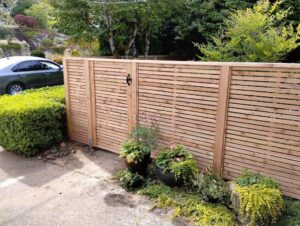 y, and it’s nice to think through the location so we have efficiency throughout the day.
It’s good for us as fence builders to picture the gate swinging in our heads – whether it swings to the left or to the right – as you walk through it. If your gate enters into an open space, it’s nice to have the gate swing away from the open space so that when you enter, you don’t have to walk around the gate to close it. It can close more naturally.
7) Move fragile garden or landscape items away from the work area. Items can accidentally be trampled on and machine cords may drag, catch, and damage items. Therefore, special landscape items like gnomes, flamingos, and buddhas should be moved for their safety. Moving said items can save time, money, and awkward future conversations about compensation for the fence company damaging them.
8) Make sure the fence building crew has access to water and reliable power supply. Older homes typically have one or two exterior outlets, but it’s best to check these resources to make sure they work prior to the crew showing up.
For older homes, we often run power from garages, or through an open window to the closest available outlet. Unless the homeowner is still at the house, which is preferable, it’s also good for the crew to have access to the breaker box if one gets tripped while working in the rain. Water has been known to trip breakers.
9) Space for parking is important for the install crew. It’s most efficient if the fence building company has their company work van as close to the project site as possible. If there’s a parking spot the homeowner normally uses, it’s more efficient to allow the van to be parked there, which optimizes time of completion.
10) We deliver the fencing material prior to the start of the project so all the materials are available and ready prior to the crew showing up. We use a crane truck where we drop the material directly adjacent to the truck, so the drop location needs to be where we can access it easily.
It’s best for the fence material to be dropped as close to the fence work as possible for the efficiency of the fence build. If the fence is built in the backyard, then the material can be dropped from the alley (if one is present and available). If the client can review where this drop location can be with the fence builder prior to delivery, such forethought benefits everyone.
10) It’s common for the dirt that’s dug out of the ground for the fence posts to be left onsite. Rain City Fence typically digs the holes and places the dirt in trash bags we can then carry anywhere on your property. Please review this location with the lead project builder prior to the fence building project.
We hope these tips will make your home’s fence build an easier, more economical, efficient, and pleasurable experience. If you’re on the hunt for a free quote or general inquiry, we would be pleased to speak with you.
continue reading
Related Posts
If you’re researching cedar fence cost Bellevue homeowners typically pay, […]

If you’re planning cedar fences Bellevue homeowners rely on for […]